Facebook
 Google
 GitHub
 Linkedin
Beyond the Blades: 6 Innovations Challenging Wind Turbine Design
Could the traditional three-blade wind turbine design soon become outdated? Six imaginative designs are offering alternatives to the tried-and-true “windmill.”
While large wind developers focus on building taller and more powerful conventional wind turbines, several smaller companies—mostly startups—are creating wind generators with multiple, smaller, and oddly shaped blades. Some turbine designs have no blades at all.
These innovative turbines function based on basic wind power principles: flowing wind activates moving parts, and mechanical energy is converted to electrical energy, creating electricity. The wind devices generally fall into two camps: the vertical axis turbine and the passive flow wind device. However, they differ greatly in size, shape, and intended use.

The Windcatcher compared to a traditional wind turbine. Image used courtesy of Wind Catching Systems
Most unconventional wind turbines are in limited use, concept, or prototype stages, but some startups are well-funded and backed by established players in renewable energy, including Bill Gates. Gates’ Breakthrough Energy Ventures was among the investors in Airloom Energy, a company producing small, interconnected vertical-axis wind turbines.
Companies like Airloom successfully harvest wind energy with less expense, waste, noise, and environmental impact than traditional wind developments. Some turbine designs are suitable for microgrids or other small-scale uses, while a few startups have ambitions to offer grid-scale power. If they succeed, the wind farm landscape could look radically different.
1. Windcatcher: Gigantic, Powerful, Modular
Traditional offshore wind systems are costly and time-consuming to install. Turbine sizes are enormous to maximize wind generation. For instance, the Vestas V236-15.0 MW stands 280 meters tall and generates enough electricity to power 20,000 homes.
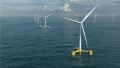
Norway-based Wind Catching Systems claims it can beat Vestas’ height and power while avoiding the installation costs and difficulties. The Windcatcher prototype towers at 300 meters and reportedly can power 80,000 homes. But it’s not a single turbine—the Windcatcher consists of multiple small, lightweight, modular horizontal turbines stacked together. The floating system’s slim profile takes up less acreage than a typical offshore floating platform.
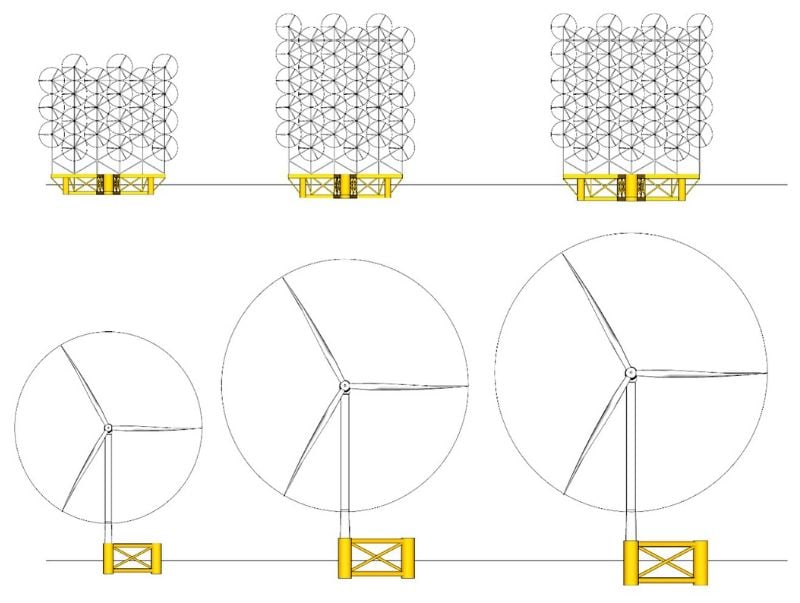
Windcatchers compared to conventional turbines. Image used courtesy of Wind Catching Systems
2. Bladeless Wind Turbines
Vortex Bladeless, a Spanish startup, has dispensed with blades altogether. Its turbine consists of a vertical cylinder that shakes when the wind blows from any direction. The company claims it is easy to install, requires minimal maintenance, and makes little noise. The lack of blades makes it harmless to wildlife.
Video used courtesy of Vortex Bladeless
The device builds on the theory of vortex shedding. The blowing wind around the turbine creates vortexes of low and high pressure. The fluctuating pressure causes the turbine to vibrate. The movement stimulates copper coils and magnets inside the Vortex device to generate electricity.
4. Aeromine: Passively Catching the Wind
Aeromine Technologies’ bladeless turbine is designed for installation on flat rooftops of businesses, warehouses, and data centers. The passive turbine catches and amplifies the wind by creating a low-pressure zone behind the device. The wind rushes through and spins a propeller, which generates the power.
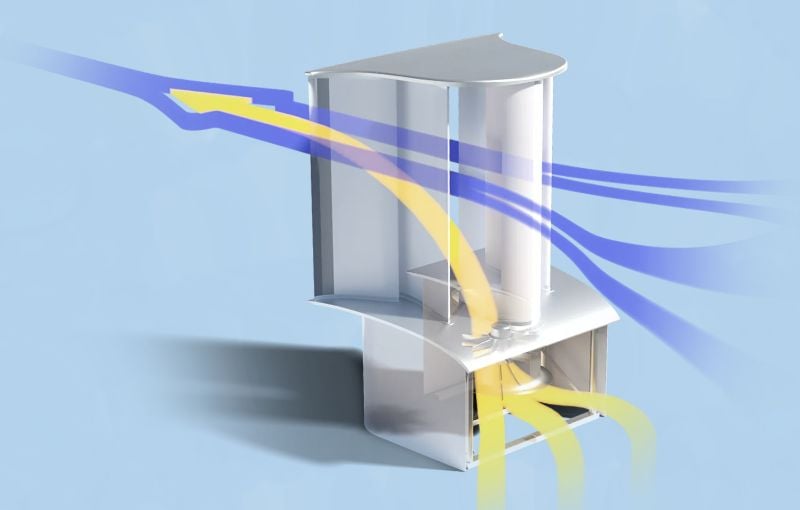
Illustration of the Aeromine turbine’s operation. Image used courtesy of Aeromine Technologies
The Aeromine turbine can be used singly or in combination. It works best on buildings 25-65 feet tall and less than 150 feet long. The company recommends that users install the device facing the prevailing wind direction.
4. Aeroleaf Takes Its Cues From Nature
Taking a lesson from nature, New World Wind has created a wind generator resembling a tree. Each leaf—or Aeroleaf—is a small, plastic vertical-axis turbine with a microgenerator containing permanent magnets. Designed for microgrids, it can work with AC or adapt to DC.
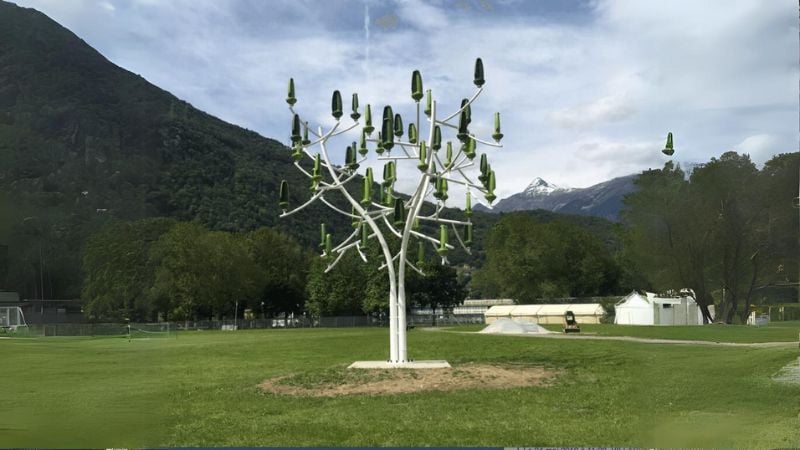
Aeroleaf’s tree-like wind device. Image used courtesy of Aeroleaf
The Aeroleaf rotates to capture wind from any direction. It’s noiseless and can be combined with small solar panels for a hybrid system. The turbine is commercially available.
5. IceWind for Harsh Environments
Iceland-based IceWind, Inc. promotes its device for use in extreme conditions and remote areas. The vertical-axis turbine mounts atop a tower or framework for off-grid use.
Video used courtesy of IceWind
The turbine is 5 feet tall and nearly as wide in diameter. It has three outer and three inner blades that can catch wind from all directions. The larger outer blade can handle winds up to 130 mph, while the inner blade is designed for slower winds up to 4.5 mph. It can generate 600 W. The company states the device has a 20-year life and needs little or no maintenance.
6. Wind Harvester: Ready for Grid Power?
The vertical-axis Wind Harvester is intended to supplement traditional horizontal turbines on wind farms. The company claims adding the device to an existing wind farm will increase its energy output. The shorter tower can take advantage of midlevel winds from 15 to 100 feet above the ground.

Concept of the Wind Harvester alongside conventional turbines. Image used courtesy of Wind Harvest
The rotor assembly is nearly square, about 13 by 13 meters, and the swept area is 169 square meters. The tower ranges in height from 8 to 20 meters. London-based Wind Harvest says the turbine generates 122-310 MWh of electricity annually.